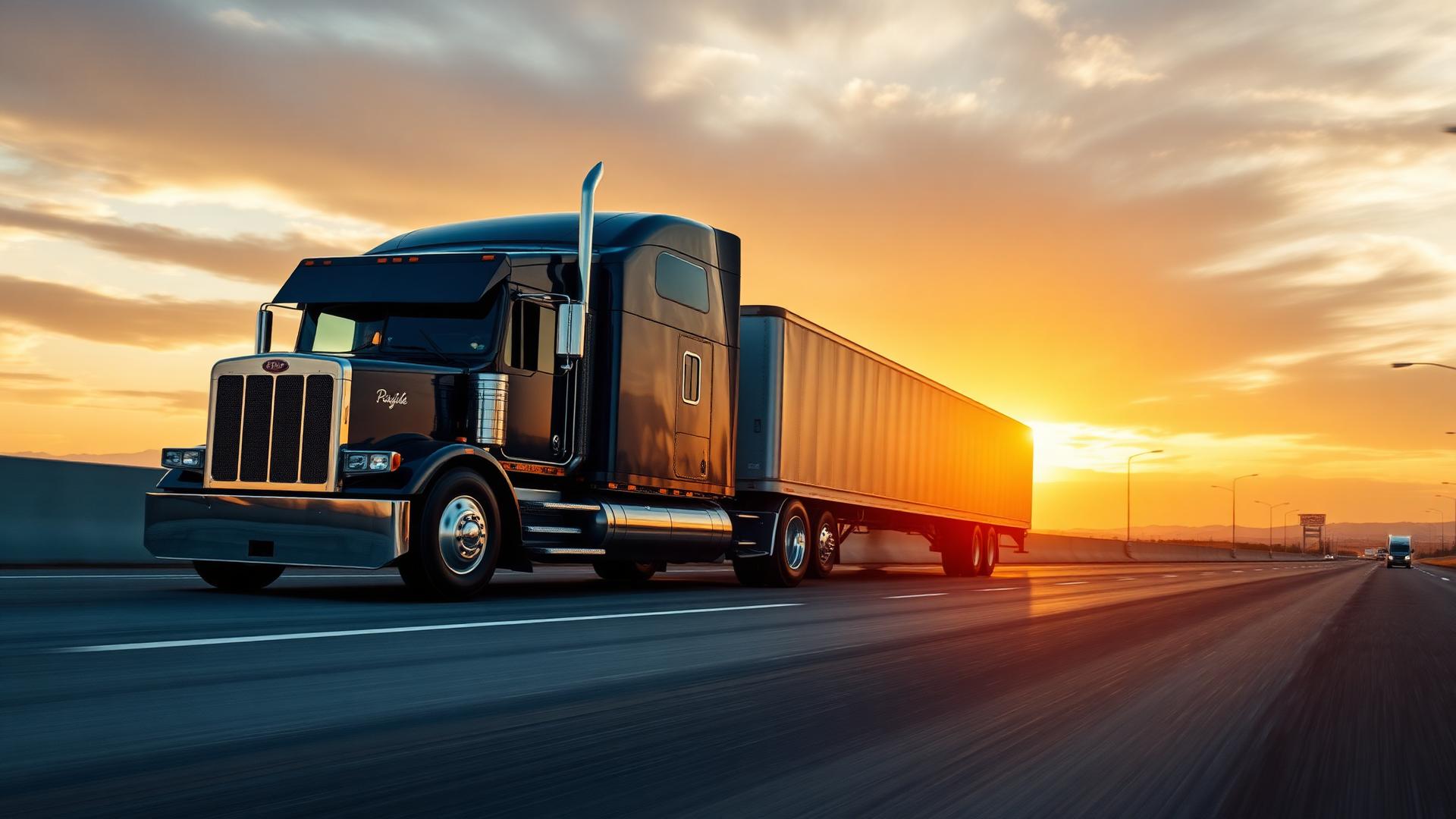
How to Finance a Semi Truck
Buying your first tractor is the single biggest financial decision most drivers ever make, and the way you finance it determines whether the truck becomes an income machine or an anchor. A semi truck loan is equipment financing secured by the tractor itself. The funding partner holds a lien on the unit, which is exactly why approvals reach further here than in unsecured business lending: if the note goes bad, there is a liquid national market for a clean sleeper.
The process runs in five steps. First, pre-qualify with a soft credit inquiry so you know your budget and structure before a salesperson ever quotes you a payment. Second, shop the truck with that number in hand — a pre-qualified buyer negotiates from strength. Third, submit the unit details: year, make, model, mileage, VIN and the seller's invoice. Fourth, underwriting reviews your credit, time in business, CDL and driving history, bank statements and down payment. Fifth, documents are signed and the funding partner pays the seller directly, usually within one to three business days for a straightforward file.
Typical semi truck financing in the current US market runs $40,000 to $200,000 over 36 to 72 months, with down payments from zero for established carriers up to 25 or 30 percent for startups and credit-challenged buyers. The rate you are quoted is a function of four levers you actually control: credit profile, down payment, the age and mileage of the truck, and how long you have been operating under your own authority.
Semi Truck Loan Rates, Terms and Down Payments
Rates in commercial equipment finance are quoted as a simple interest rate or as a money factor on a lease, and they vary widely by profile. Established carriers with strong credit see the sharpest pricing and the longest terms. Owner-operators in their first two years pay a premium that reflects the statistical reality that new authorities fail at a high rate in year one. Credit-challenged buyers pay the most, but the truck still gets financed because the collateral does the heavy lifting.
Term length deserves more thought than most buyers give it. A 72-month note on a 900,000-mile glider is a trap — you will still owe money on a truck that has stopped earning. Match the term to the realistic remaining service life of the unit. A good rule of thumb: newer trucks under 400,000 miles can carry 60 to 72 months, units between 400,000 and 700,000 miles suit 36 to 60 months, and anything beyond that should be financed over 24 to 48 months or bought outright if you can.
Down payment is the most powerful lever available to a borrower. Moving from 10 percent down to 25 percent down frequently improves the rate, shortens the approval time, and can be the difference between a decline and an approval for a first-time owner-operator. It also protects you from being upside down in the first two years, which matters if a health issue, a market downturn or a mechanical disaster forces an early sale.
Owner-Operators and New Authority: Financing Your First Truck
The jump from company driver to owner-operator is the most patriotic bet in American business — betting on yourself, on your own hands and your own hours, in an industry that hauls seventy-two percent of the nation's freight tonnage. Funding partners know this transition well and have built programs for it, but they underwrite it carefully.
What a startup owner-operator file needs: two or more years of verifiable CDL Class A driving experience, a clean MVR without recent serious violations, a down payment of 10 to 25 percent, a personal guarantee, and a credible plan for freight. That last item is where applications live or die. A dedicated lane, a signed dispatch agreement, a strong broker relationship or a lease-on offer with a reputable carrier all demonstrate that the truck has work waiting. A hopeful plan to 'run the load boards' is not a plan.
Build your cost model before you sign anything. Beyond the note, budget for insurance (typically $800 to $1,600 a month for a new authority), fuel, tires and maintenance reserves, permits and IFTA, ELD service, parking, and a genuine cash cushion for a blown turbo or an after-treatment failure. Operators who fail rarely fail because the truck payment was too high — they fail because there was no reserve when the truck was down for eleven days.
New vs Used Semi Trucks: How the Financing Changes
A new sleeper — Freightliner Cascadia, Kenworth T680, Peterbilt 579, Volvo VNL, International LT — typically prices from $150,000 to $200,000 plus. New units attract the best rates and the longest terms because the collateral is pristine and factory warranty protects the revenue stream. For high-mileage operations running 120,000 miles a year, the fuel economy and downtime savings on a new truck often outweigh the larger payment.
Used tractors are where most first-time owner-operators start, and the financing rules tighten with age. A three-to-five-year-old truck with 400,000 to 600,000 miles is the sweet spot: the steepest depreciation has already happened, the price sits in the $60,000 to $95,000 range, and the unit still finances conventionally. Beyond seven years or 800,000 miles you move into specialty programs with bigger down payments and shorter terms.
Never finance a used tractor without an independent pre-purchase inspection and a full ECM download. Pay particular attention to the after-treatment system — DPF, DEF and EGR repairs regularly run five figures — plus the turbo, clutch, king pins, frame rails and any evidence of accident repair. A $500 inspection is the cheapest insurance in trucking.
Bad Credit Semi Truck Financing
Damaged credit does not close the door on a semi truck loan; it changes the structure. Programs exist into the 550s and occasionally below, and they work by shifting risk into terms you can influence: a down payment of 20 to 30 percent, a shorter term, a newer and more liquid unit as collateral, and clean recent bank statements without unexplained negative days.
Two things carry disproportionate weight in a subprime file. The first is a coherent explanation of what caused the damage — a divorce, a medical event, a failed prior authority during a freight downturn — paired with evidence of what has changed since. The second is consistent recent deposits. Six months of steady settlement income does more for an application than a marginal score improvement.
Be careful with the predatory edge of this market. Weekly-payment programs advertised heavily at credit-challenged drivers can carry effective annual costs far beyond what the small payment suggests, and a single slow week can put you in default. Dealer 'guaranteed approval' lots often bake the risk into an inflated truck price, so you overpay for the equipment and the money at the same time. A soft-pull pre-qualification through an independent platform lets you see genuine options before you set foot on a lot.
Loan vs Lease, Documents, and What Happens Next
A conventional equipment loan means you own the tractor outright at the end, build equity with every payment, and can spec, modify, or sell the truck as you see fit. A TRAC lease reduces the monthly outlay and offers a stated purchase price at the end of the term, which suits carriers who cycle equipment on a schedule or who need to preserve cash for a second and third truck. What you should approach with caution is a carrier lease-purchase, where your truck, your freight, your dispatch and your settlement all sit with one company — if the relationship ends, everything ends at once.
Documentation is lighter than most drivers expect. Typically: your driver's license and CDL, three to six months of business or personal bank statements, your MC and DOT numbers if you have authority, a completed application, and the truck's details and invoice once you have a unit selected. Buyers who have not chosen a truck yet can still pre-qualify for an amount, which is the right order of operations.
America's semi truck drivers are the backbone of this country — the men and women who keep every shelf stocked, every hospital supplied and every factory running through weather, holidays and hard years. TruckLoansAi.com is a technology platform that connects those drivers with licensed US funding partners who understand trucking economics. Pre-qualification is free, uses a soft credit inquiry, and carries no obligation whatsoever.
Semi Truck Loan Rates: What the Numbers Actually Look Like
Rate quotes on Class 8 equipment are built from a base cost of funds plus a risk margin, and the margin is where every dollar of your payment is won or lost. Across the partners we refer to, the spread between the best and worst pricing on the same $95,000 tractor is routinely 20 percentage points of APR — roughly $1,000 a month on a 60-month note. That gap is not luck. It is credit tier, authority age, truck age and deposit, in that order of weight.
Work an example. A $95,000 sleeper with 10 percent down finances $85,500. At 9 percent over 60 months the payment is about $1,775 and total interest about $21,000. At 14 percent the payment is about $1,990 and interest about $33,900. At 22 percent it is roughly $2,360 and $56,000. Same truck, same freight, three completely different businesses at the end of five years. Every point you can move — by adding deposit, by waiting until you clear 12 months of authority, by choosing a 2021 instead of a 2016 — is real money back in your pocket.
Term length is the other lever, and it cuts the opposite way. Stretching from 48 to 72 months lowers the monthly payment by roughly 25 percent but can add 50 percent or more to lifetime interest, and it risks leaving you upside down when the truck needs replacing. The disciplined structure most experienced operators land on is the shortest term whose payment still clears comfortably in your worst freight month, not your best.
Down Payment Reality for Class 8 Tractors
Zero-down semi truck financing exists, but it is priced. It is genuinely available to established carriers with clean payment histories and strong credit; for everyone else, an advertised zero-down offer usually reappears as a higher rate, a shorter term, a larger security deposit or a lease with a substantial end buyout. On a $95,000 truck, putting 10 percent down instead of nothing frequently moves the quote enough to pay the deposit back in saved interest well before the note matures.
The practical brackets right now: established carriers 0 to 10 percent, new authority owner-operators 10 to 25 percent, credit scores in the 550 to 620 band 20 to 30 percent, and high-mileage or older tractors 20 to 35 percent. On a $60,000 unit that is $6,000 to $18,000; on a $150,000 unit, $15,000 to $45,000. Trade-in equity counts as deposit with most partners, and a seasoned trade with a clean title is often the fastest way to close the gap.
One thing to protect: do not empty your reserves into the deposit. Underwriters look at the bank balance you keep, not only the cheque you write. An applicant who puts 10 percent down and holds two months of operating cash presents a stronger file than one who puts 25 percent down and shows a near-zero balance the following week.
Semi Truck Loan Rates This Week
Checked week of October 12, 2026Our automated rate monitor reviews commercial truck lending conditions across all 50 states every Monday. These are this week's national averages for Class 8 tractors.
| Borrower tier | Typical APR | What it means |
|---|---|---|
| 700+ FICO, 2+ yrs authority | 8.68% – 11.13% | Best-tier paper. Full documentation, newest equipment. |
| 660–699 FICO, 1–2 yrs authority | 11.13% – 14.79% | Standard A/B paper. Most established owner-operators sit here. |
| 600–659 FICO or under 1 yr authority | 14.79% – 19.98% | B/C paper. Larger deposit usually trades down the rate. |
| 550–599 FICO, prior derogatory items | 19.98% – 29.68% | C/D paper. Asset-backed placement, shorter terms. |
| Typical down payment | 1% – 21% | Zero-down is reserved for seasoned files; new authorities plan on 10–20%. |
| Common terms | 36, 48, 60 and 72 months | Older or higher-mileage trucks are held to shorter terms. |
National average of this week's 50-state rate check across licensed US commercial truck funding partners.
Rates are reviewed every Monday by our automated rate monitor across all 50 states and are illustrative market ranges, not an offer of credit. Your actual rate is set by the licensed funding partner after underwriting.
Semi Truck Loan Structures at a Glance
| Buyer profile | Down payment | Typical term | Notes |
|---|---|---|---|
| Established carrier, 660+ credit | 0–10% | 60–72 months | Best pricing; new tractors qualify |
| New authority owner-operator | 10–25% | 48–60 months | 2+ years CDL experience expected |
| Credit score 550–620 | 20–30% | 36–48 months | Tractor secures the note |
| High-mileage used tractor | 20–35% | 24–48 months | Inspection and ECM download advised |
Ranges are general market illustrations, not offers. Actual pricing is set by the funding partner after underwriting.
Truck Financing Calculator
Estimate a monthly payment on a semi truck loan. Move the numbers to match your truck, down payment, rate quote and term.
- Monthly payment
- $1,775.90
- Down payment
- $14,250
- Amount financed
- $80,750
- Total interest
- $25,804
Illustrative estimate only — not an offer, quote, or commitment to lend. Actual rates, terms and payments are set by the funding partner after underwriting.