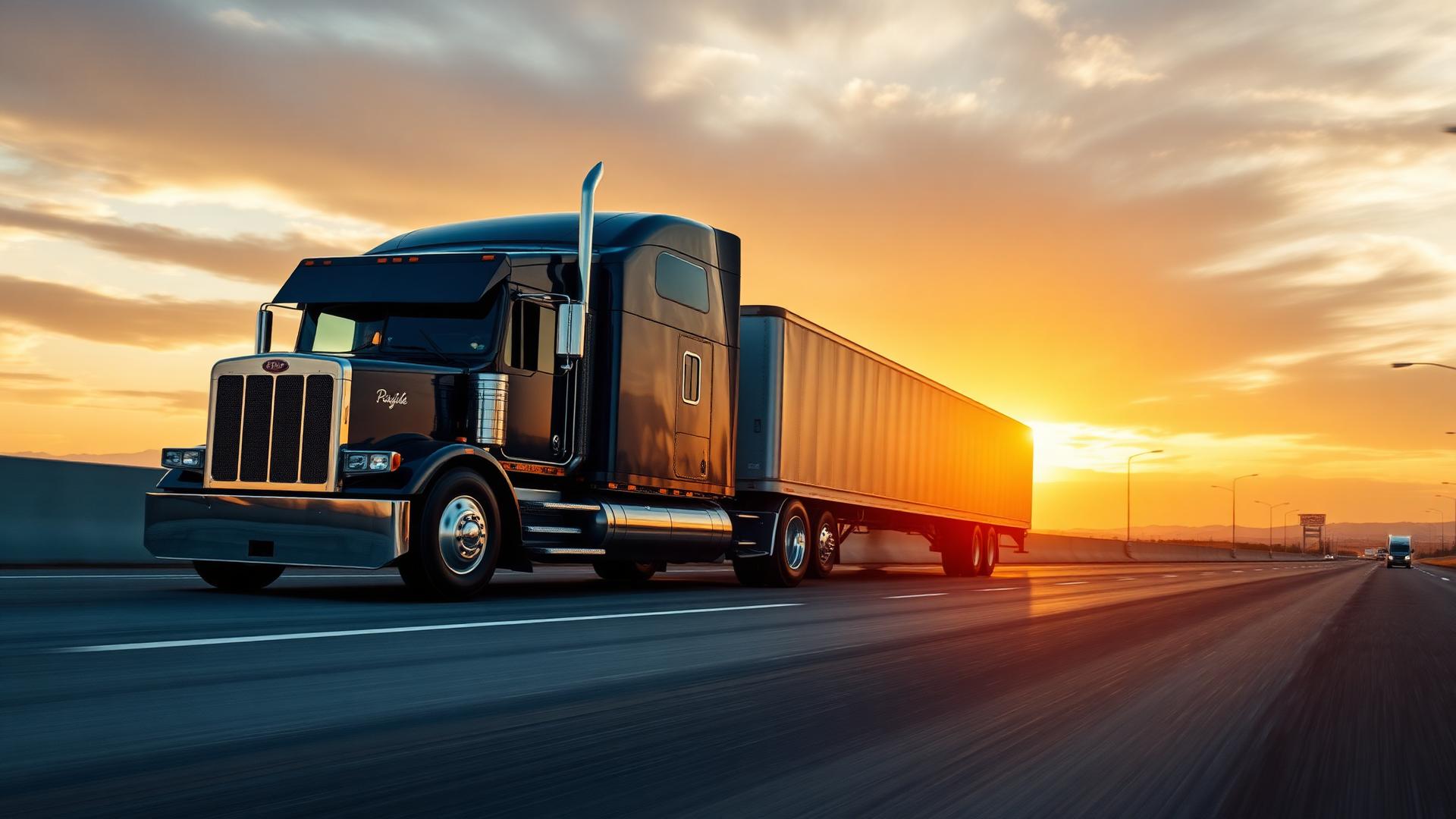
Owner Operator Truck Financing: Betting on Yourself
There is no more American decision than the one an owner-operator makes: to stop driving someone else's truck and start building something of your own. Roughly 350,000 owner-operators keep freight moving across this country, and every one of them started at the same crossroads — a truck they wanted, and a financing question they had to answer first.
Owner operator truck financing is equipment lending secured by the truck itself. That single fact is why this door stays open to people the banks turn away. An unsecured business loan asks a lender to trust your paperwork; an equipment loan asks it to trust a tangible asset with a national resale market. If the note fails, the truck can be recovered and sold, so funding partners can take chances on thin files, short histories and imperfect credit that no commercial bank would touch.
In practice this means a first-time owner-operator can realistically finance a $60,000 to $95,000 used sleeper, or a $30,000 to $70,000 day cab or straight truck, over 36 to 60 months with 10 to 25 percent down. The application does not begin with a score — it begins with the whole picture: your experience behind the wheel, your driving record, your cash in hand, and where your loads will come from.
How to Finance a Truck With No Credit
No credit is not the same as bad credit, and it is important that you say so on your application. A thin file usually means you are young, newly arrived in the country, or someone who has simply lived without borrowing. Underwriters read that very differently from a file full of charge-offs — but they still need something to underwrite, so you have to supply that something yourself.
There are four proven paths. The first and strongest is a larger down payment: 20 to 35 percent down gives the funding partner an equity cushion that makes the score almost irrelevant. The second is a co-applicant with established credit — a spouse, a parent, a business partner — which frequently converts a decline into an approval and lowers the rate at the same time. The third is documented income: six months of bank statements showing steady deposits from driving work, plus a lease-on offer, dispatch agreement or dedicated lane letter proving the truck will earn from week one. The fourth is collateral quality: choose a newer, lower-mileage, mainstream-make truck. A five-year-old Cascadia or T680 is far easier to finance with no credit than a specialty unit or a 900,000-mile glider.
While you are arranging financing, start building credit in parallel, because your second truck should cost you less than your first. A secured credit card used lightly and paid in full, a fuel card in the business's name that reports to commercial bureaus, and a D-U-N-S number for your LLC will begin producing a real file within six months. Every on-time payment on your first truck note also reports, and lenders in this segment re-underwrite payment history aggressively — twelve clean months on your first unit is often worth more than a hundred points of consumer score.
Bad Credit Truck Financing for Owner-Operators
If your credit is damaged rather than absent, the strategy shifts. Programs exist into the 550s and occasionally below, and they work by moving the risk into terms you can influence: a down payment of 20 to 30 percent, a term of 24 to 48 months instead of 60, and a well-chosen unit as collateral. The rate will be higher than prime. Whether that is acceptable comes down to one honest calculation — does the freight you have lined up cover the payment, insurance, fuel, maintenance reserve and your own wage, with margin left over? If it does, the truck is worth buying. If it only works in a perfect month, it is not.
Two things carry unusual weight in a subprime file. First, an explanation. Divorce, a medical event, a failed authority during the 2023 freight recession — underwriters have seen all of it, and a straightforward account of what happened and what changed reads far better than silence. Second, recent bank activity. Clean statements with consistent deposits and no unexplained negative days will do more for you than a marginal score bump.
Guard yourself against the predatory edge of this market. Weekly-payment programs marketed hard at credit-challenged drivers can carry effective annual costs multiples above what the small payment implies, and a single slow week can trigger default. 'Guaranteed approval' dealer lots frequently bury the risk in an inflated truck price, so you overpay for both the equipment and the money. Getting a soft-pull pre-qualification through an independent platform before you shop is the single best protection available to a driver with bruised credit.
What Underwriters Look At Beyond the Score
Driving experience is the first thing reviewed. Two years of verifiable Class A experience is the common threshold for a startup owner-operator program, and your MVR matters as much as the years — recent serious violations, a DUI, or a pattern of preventable accidents will do more damage to an application than a mediocre credit score.
Next is the freight plan. This is where most first-truck applications succeed or fail. A signed lease-on agreement with a reputable carrier, a dedicated lane, a documented dispatch service arrangement, or an established broker relationship all show the truck has work waiting. 'I'll run the load boards' is not a plan and underwriters know it.
Then the money. Funding partners want to see the down payment sitting in an account, not promised from a future settlement, and they want evidence of a reserve beyond it. Beyond the note, your monthly reality includes insurance (typically $800 to $1,600 for a new authority), fuel, tires, a maintenance reserve of at least $0.15 per mile, permits and IFTA, ELD service, parking and your own living costs. Owner-operators rarely fail because the payment was too high — they fail because there was no cash when the truck sat for eleven days waiting on an after-treatment part.
Choosing the Right First Truck
The truck you finance first should be boring, mainstream and inspectable. Mainstream because parts and service are everywhere and resale is liquid, which both keeps you running and keeps your lender comfortable. The three-to-five-year-old range with 400,000 to 600,000 miles is generally the sweet spot: the steep depreciation has already happened, the price is financeable, and the unit has real service life left.
Never buy without an independent pre-purchase inspection and a full ECM download. Focus the inspection on the after-treatment system — DPF, DEF and EGR failures routinely run five figures — plus the turbo, clutch, king pins, frame rails and any sign of accident repair. The ECM download tells you the truth about how the truck was actually driven, including idle hours and hard-brake events, which no seller's story will.
Match the term to the truck. Financing a 750,000-mile tractor over 72 months to reach a comfortable payment is how operators end up owing money on equipment that no longer earns. It is better to buy slightly less truck on a shorter note and own it clean.
Your Next Step
Start with pre-qualification, not with a dealer lot. A soft-pull pre-qualification tells you your realistic budget and structure in minutes without touching your credit score, and walking onto a lot already knowing your number is the strongest negotiating position a buyer can hold. Sales staff quote payments; you should be quoting price.
You will typically need your driver's license and CDL, three to six months of bank statements, your MC and DOT numbers or lease-on documentation, and the truck's year, make, model, mileage and invoice once you have chosen one. If you have not picked a truck yet, that is fine — pre-qualify for an amount first and shop within it.
America's owner-operators are the backbone of this nation. They haul the freight that stocks every shelf, supplies every hospital and feeds every factory, through weather and holidays and hard years, on their own dime and their own initiative. TruckLoansAi.com is a technology platform connecting those drivers with licensed US funding partners who understand what this work actually costs and what it can actually earn. Pre-qualification is free, uses a soft credit inquiry, and carries no obligation.
Owner-Operator Rates, Terms and Down Payments in Real Numbers
Owner-operator financing is priced off two things underwriters can verify: how long your authority has been active, and what your bank statements say about the money moving through it. A driver with 24 months of clean authority and 680 credit commonly sees 10 to 14 percent APR over 60 months with 10 percent down. The same driver at month three of a brand-new authority typically sees 16 to 22 percent and is asked for 15 to 25 percent down on the same truck.
Put that on a working example. A $75,000 used tractor with 15 percent down finances $63,750. At 12 percent over 60 months that is roughly $1,418 a month and about $21,300 in total interest. At 18 percent it is roughly $1,619 a month and about $33,400 in interest — a $12,000 swing on identical equipment. On the same $75,000 truck at 12 percent, cutting the term from 60 to 48 months raises the payment to about $1,679 but drops total interest to roughly $16,800.
Terms for owner-operators cluster at 48 to 60 months, with 72 months reserved for late-model trucks and stronger files. Most partners will not term a note past the point where the tractor is expected to have serious resale value, which is why a 2016 unit is quoted 36 to 48 months while a 2022 unit of the same price is quoted 60 to 72.
Cash Flow Math Before You Sign
The single most useful number an owner-operator can calculate before applying is cost per mile. Take your fixed costs — truck payment, insurance, plates, permits, parking, accounting — and divide by expected monthly miles; then add variable costs of fuel, tyres, maintenance and tolls. Most single-truck operations land between $1.65 and $2.10 per mile all-in. If the lanes you are being offered pay $2.20, the business works; if they pay $1.80, one breakdown ends it.
Keep the truck payment under roughly 20 to 25 percent of average monthly gross. At $18,000 monthly gross that is $3,600 to $4,500 of headroom, and prudent operators sit well below the ceiling because insurance renewals, a $6,000 turbo or a two-week deadhead stretch all arrive without warning. Maintenance reserve of $0.12 to $0.18 per mile — about $1,000 to $1,500 a month at 8,000 miles — is not optional; it is the difference between a repair and a repossession.
Underwriters look for the same discipline. Three to six months of bank statements showing consistent deposits, no repeated overdrafts and a retained balance after the deposit is paid will move your pricing more than almost anything else you can do in the 90 days before you apply.
Owner-Operator Truck Loan Rates This Week
Checked week of October 12, 2026Checked every Monday across all 50 states. Owner-operators under 12 months of authority usually price at the fair or challenged tiers until the authority seasons.
| Borrower tier | Typical APR | What it means |
|---|---|---|
| 700+ FICO, 2+ yrs authority | 8.68% – 11.13% | Best-tier paper. Full documentation, newest equipment. |
| 660–699 FICO, 1–2 yrs authority | 11.13% – 14.79% | Standard A/B paper. Most established owner-operators sit here. |
| 600–659 FICO or under 1 yr authority | 14.79% – 19.98% | B/C paper. Larger deposit usually trades down the rate. |
| 550–599 FICO, prior derogatory items | 19.98% – 29.68% | C/D paper. Asset-backed placement, shorter terms. |
| Typical down payment | 1% – 21% | Zero-down is reserved for seasoned files; new authorities plan on 10–20%. |
| Common terms | 36, 48, 60 and 72 months | Older or higher-mileage trucks are held to shorter terms. |
National average of this week's 50-state rate check across licensed US commercial truck funding partners.
Rates are reviewed every Monday by our automated rate monitor across all 50 states and are illustrative market ranges, not an offer of credit. Your actual rate is set by the licensed funding partner after underwriting.
No-Credit and Thin-File Paths at a Glance
| Your situation | Down payment | Typical term | What strengthens the file |
|---|---|---|---|
| No credit history at all | 20–35% | 36–48 months | Co-applicant, bank statements, newer unit |
| Thin file, 2+ years CDL | 15–25% | 48–60 months | Lease-on offer or dedicated lane |
| Damaged credit, 550–620 | 20–30% | 24–48 months | Clean recent statements, written explanation |
| Second truck, 12 months on-time | 10–20% | 48–72 months | Payment history on the first note |
Ranges are general market illustrations, not offers. Actual pricing is set by the funding partner after underwriting.
Truck Financing Calculator
Estimate a monthly payment on a semi truck loan. Move the numbers to match your truck, down payment, rate quote and term.
- Monthly payment
- $1,402.03
- Down payment
- $11,250
- Amount financed
- $63,750
- Total interest
- $20,372
Illustrative estimate only — not an offer, quote, or commitment to lend. Actual rates, terms and payments are set by the funding partner after underwriting.